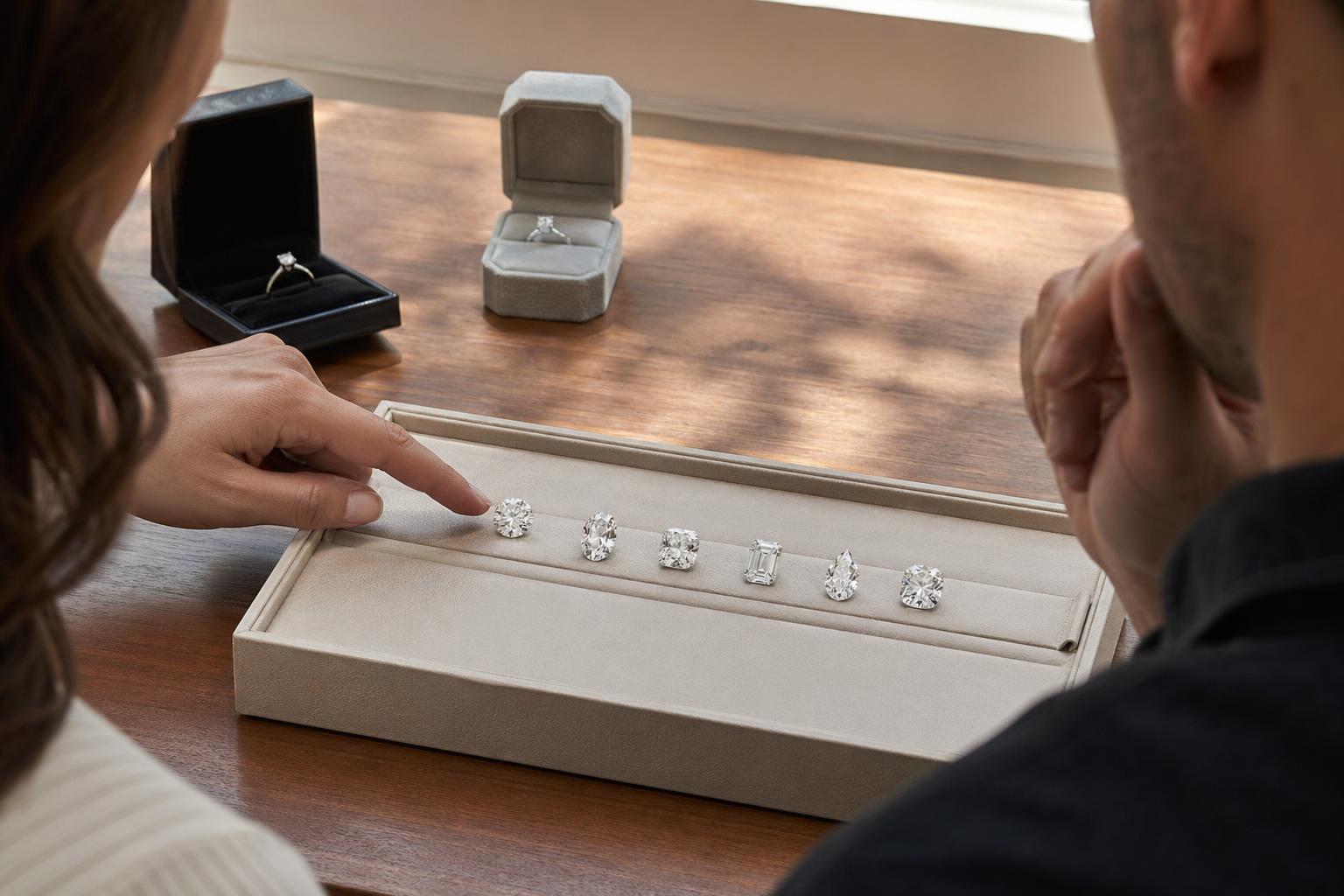
Choosing a diamond shape is one of those decisions that feels deceptively simple until you're staring at eight different options on a screen, trying to figure out which one will look best on your partner's hand. The shape you pick affects everything: how much the stone sparkles, how large it appears, how it flatters the finger, and how far your budget stretches. And because lab-grown diamonds are chemically and optically identical to mined stones, every shape performs exactly as you'd expect from a natural diamond, just at a fraction of the cost. That price difference actually changes the game when it comes to shape selection, because you can afford to go bigger or choose fancy cuts that might have been out of reach with a mined stone. Whether you're drawn to a timeless round or something more unconventional like a marquise, understanding how each shape behaves in a lab-grown stone will help you make a confident choice. The best lab-grown diamond shapes for engagement rings depend on a mix of personal style, hand shape, and what kind of brilliance you're after. Here's what actually matters when narrowing it down.
Understanding Lab-Grown Diamond Brilliance and Popularity
Lab-grown diamonds have surged in popularity over the past five years, and the numbers tell the story clearly. According to industry reports, lab-grown stones accounted for roughly 50% of engagement diamond sales in 2023, up from about 10% just five years prior. That explosive growth isn't just about price, though saving 30-60% compared to mined diamonds certainly helps. Couples are drawn to the ethical transparency and the ability to get a larger, higher-quality stone within their budget.
The shape you choose directly impacts how a lab-grown diamond interacts with light. Because these stones are grown under controlled conditions, they tend to have fewer inclusions, which means many shapes that are sensitive to clarity issues, like emerald and asscher cuts, perform exceptionally well in lab-grown versions. You're essentially getting a cleaner canvas for whatever shape appeals to you.
The Sparkliest Diamond Shapes for Man-Made Stones
If raw sparkle is your priority, the round brilliant cut wins by a wide margin. Its 57-58 facets are mathematically optimized to reflect the maximum amount of light back to your eye. But "sparkle" isn't one-dimensional. There's brilliance (white light return), fire (rainbow flashes), and scintillation (the pattern of light and dark as the stone moves).
Oval and radiant cuts come in second for overall sparkle, though they express it differently. Ovals produce broad flashes of light across their larger surface area, while radiants combine the step-cut silhouette with brilliant-cut faceting for intense fire. Cushion cuts offer a softer, more romantic sparkle that some people prefer to the "disco ball" effect of a round brilliant. For lab-grown stones specifically, the consistent crystal structure means these sparkle characteristics tend to be very reliable across different specimens.
Most Popular Lab Diamond Cuts for Modern Brides
Round brilliants still dominate overall sales, accounting for roughly 40-45% of all engagement ring diamonds. But the gap is closing. Oval cuts have exploded in popularity and now represent about 25% of engagement ring purchases, a dramatic shift from just a decade ago when they were considered niche.
Emerald cuts are having a serious moment too, driven partly by celebrity engagement rings and partly by the modern, architectural aesthetic they offer. Pear shapes and cushion cuts round out the top five. What's interesting about the lab-grown market specifically is that brides tend to be slightly more adventurous with shape selection. The lower price point encourages experimentation, so fancy shapes like marquise and radiant cuts see higher proportional sales in the lab-grown segment than in the mined diamond market.
The Great Debate: Oval vs Round Lab Diamonds
This is the comparison that comes up most often, and for good reason. Round and oval are the two most popular shapes, and they appeal to somewhat different aesthetics while both delivering excellent brilliance. The choice between oval vs round lab diamonds often comes down to whether you want classic tradition or modern elegance.
Classic Round Brilliant: The Gold Standard for Fire
The round brilliant has been the default engagement ring diamond since Marcel Tolkowsky published his ideal proportions in 1919. There's a reason it's endured for over a century: no other shape returns as much light to the viewer. A well-cut round brilliant in ideal proportions (table between 54-57%, depth between 61-62.5%) will outperform every other shape in standardized light performance metrics.
For lab-grown rounds, pay close attention to cut grade. The GIA and IGI both grade round brilliant cut quality, and the difference between an Excellent and Very Good cut is visible to the naked eye. Because lab-grown diamonds cost less, you can afford to be picky here. A 1.5-carat lab-grown round in Excellent cut, E color, and VS1 clarity might run $2,000-3,500, compared to $10,000+ for a comparable mined stone. That savings lets you prioritize cut quality without blowing your budget.
The trade-off? Rounds face up smaller than other shapes at the same carat weight. A 1-carat round measures about 6.5mm across, while a 1-carat oval spans roughly 8mm in length.
Trendy Oval Cuts: Maximizing Surface Area and Length
Ovals are the shape of the moment, and their appeal goes beyond trendiness. They offer about 10% more visible surface area than a round of the same carat weight, which means your diamond looks bigger. They also create a flattering elongating effect on the finger, which is why so many people gravitate toward them.
The key thing to watch with oval lab-grown diamonds is the bow-tie effect: a dark shadow that appears across the center of the stone. Every oval has some degree of bow-tie, but a well-cut stone minimizes it to the point where it's barely noticeable. Because you can't assess bow-tie from a grading report, always look at high-resolution photos or video of the specific stone. A length-to-width ratio between 1.35 and 1.50 tends to produce the most classically proportioned oval, though some people prefer a more elongated 1.55+ ratio.
One honest observation: ovals are so popular right now that there's a real possibility they'll feel dated in 15-20 years the way marquise cuts from the 1980s do today. If timelessness matters to you, that's worth considering.
Exploring Fancy Cut Lab Grown Diamonds
Beyond rounds and ovals, fancy cut lab-grown diamonds offer distinctive personalities that can make an engagement ring feel truly individual. These shapes tend to be 15-25% less expensive per carat than rounds, which means your budget goes even further.
Geometric Elegance: Emerald and Radiant Cuts
Emerald cuts are the minimalist's diamond. Their long, open step-cut facets create a "hall of mirrors" effect rather than the fragmented sparkle of brilliant cuts. This makes them incredibly elegant but also very transparent: every inclusion and color tint is more visible. For lab-grown emerald cuts, aim for VS2 clarity or better and a color grade of G or higher. The good news is that lab-grown stones frequently hit these marks without a steep price premium.
Radiant cuts split the difference beautifully. They have the rectangular or square outline of an emerald cut but use brilliant-style faceting underneath, producing significantly more sparkle. If you love the shape of an emerald cut but want more fire, a radiant is your answer. They're also more forgiving of slight color and clarity imperfections because the complex faceting pattern masks them well.
Romantic Silhouettes: Pear and Marquise Shapes
Pear shapes (teardrop) and marquise cuts (football-shaped) are the most dramatic options available. Both create a striking elongated look on the finger and appear larger per carat than almost any other shape. A 1-carat marquise can measure over 10mm in length, which is enormous compared to a 6.5mm round of the same weight.
The challenge with both shapes is symmetry. The two halves need to mirror each other precisely, and the pointed tips are vulnerable to chipping if not protected by the setting. V-prong tips or bezel settings solve this problem. Pear shapes work beautifully as solitaires or with halo settings, while marquise cuts look stunning in east-west orientations for a more contemporary feel. Both shapes are relatively uncommon, which appeals to brides who want something distinctive without going completely unconventional.
How to Choose the Right Diamond Shape for Your Finger
The "right" shape isn't just about the diamond itself. How it looks on the wearer's hand matters enormously, and certain shapes complement certain hand types better than others. Understanding how to choose the right diamond shape for your finger can prevent that sinking feeling of a ring that looks perfect online but wrong in person.
Elongating Shorter Fingers with Vertical Cuts
If the wearer has shorter or wider fingers, shapes that create a vertical line will be most flattering. Oval, pear, and marquise cuts all draw the eye lengthwise, creating the illusion of longer, slimmer fingers. Even an emerald cut set north-south provides this elongating effect.
For petite hands specifically, a 1-1.5 carat oval or pear in a thin band (1.5-1.8mm) creates beautiful proportions without overwhelming the finger. Avoid very wide settings or chunky halos that can make small hands look even smaller. A simple solitaire or delicate three-stone setting tends to work best.
Balancing Wide Hands with Substantial Carat Weights
Larger hands and longer fingers can carry bigger stones and wider shapes without looking disproportionate. This is where round brilliants, cushion cuts, and radiant cuts really shine, as their more compact proportions fill the finger nicely. A 2-carat round on a size 8 finger looks balanced and elegant, whereas the same stone on a size 4 finger might feel oversized.
Square and near-square shapes like princess cuts and asscher cuts also work well on wider fingers, providing substantial finger coverage. If you have longer fingers and want to avoid making them look even longer, these wider shapes prevent the elongating effect that ovals and pears create. The key is proportion: the diamond should complement the hand, not compete with it.
Maximizing Value and Aesthetics in Your Selection
The shape you choose has a real impact on your budget. Round brilliants carry a 20-30% premium over fancy shapes because of higher demand and more rough diamond waste during cutting. If you want the biggest visual impact per dollar, oval, radiant, and pear shapes deliver the most perceived size for the money.
Here's a practical framework for making your final decision. Start with the wearer's style: do they gravitate toward classic jewelry or more modern, distinctive pieces? Then consider hand shape and finger length. Finally, look at your budget and determine which shapes give you the best combination of size, quality, and sparkle within that range.
Lab-grown diamonds make this whole process more enjoyable because the financial pressure is lower. You can afford to prioritize what you actually love rather than what fits a tight budget. A well-chosen 2-carat lab-grown oval with excellent proportions will cost roughly the same as a 1-carat mined round, and it will look spectacular on the hand.
The best diamond shape for an engagement ring is ultimately the one that makes the wearer's heart skip when they look down at their hand. Trust your instincts, pay attention to proportions, and don't let trends override personal taste. A shape that resonates with who you are will still feel right decades from now, regardless of what's fashionable at the moment.