

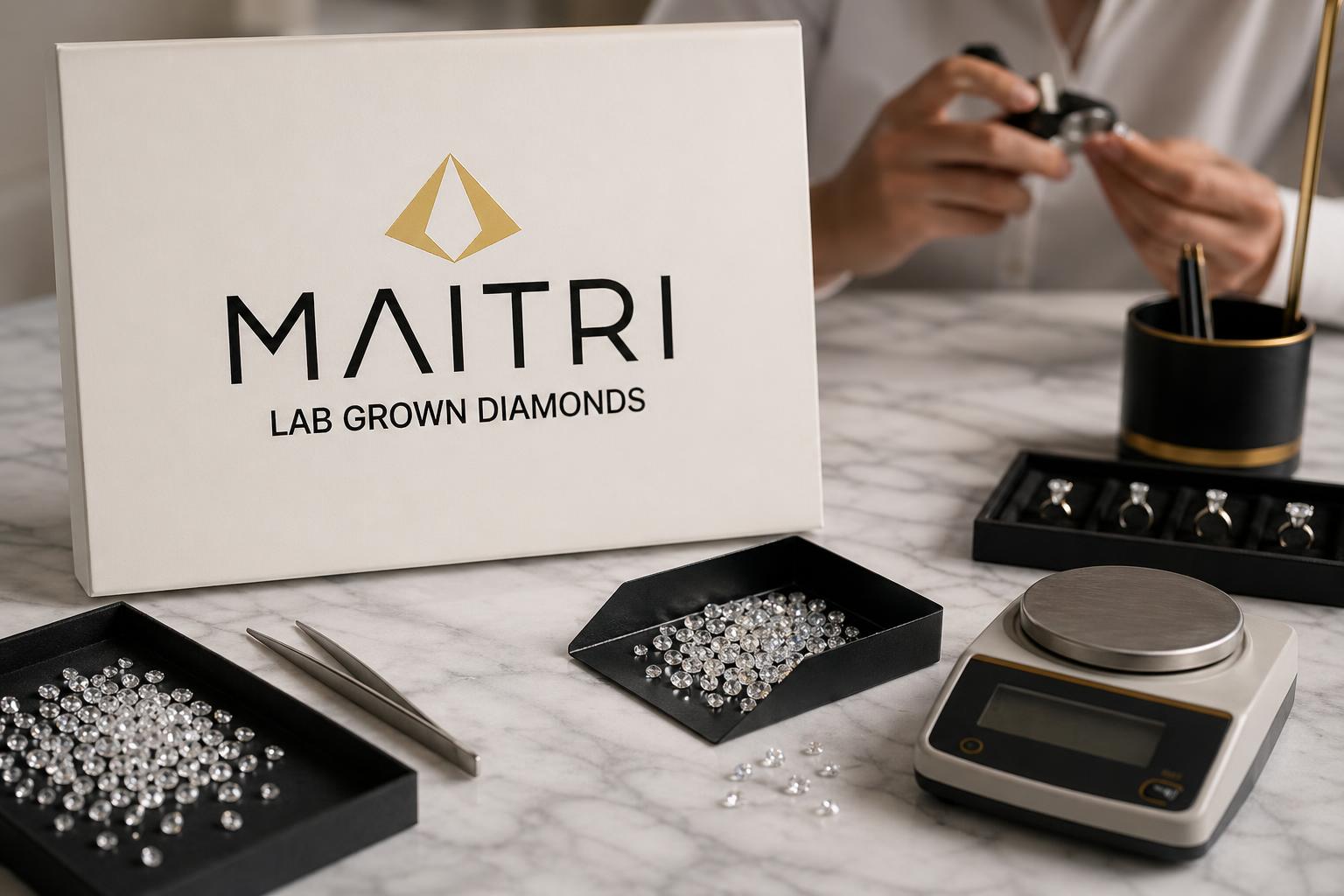
The UK lab-grown diamond market has shifted faster than most jewellers anticipated. What was once a niche curiosity is now a serious profit centre for independent retailers and bespoke designers across the country. But as supply has grown and prices have dropped, the gap between what trade buyers pay and what consumers see on the high street has become a critical commercial question. Understanding how trade pricing works for bulk lab-grown diamonds, and how retail margins are structured around them, is no longer optional knowledge for anyone serious about this sector. It is the difference between a thriving business and one that is constantly chasing the market downward. For UK jewellers sourcing stones in the 0.5 to 3 carat range, getting this right determines whether lab-grown diamonds become a genuine margin builder or just another race to the bottom.
Current Landscape of the Bulk Lab-Grown Diamond Market
The global production of lab-grown diamonds has roughly doubled every two to three years since 2018, and the effects on pricing have been dramatic. Wholesale prices for a 1 carat, G colour, VS1 clarity round brilliant have fallen from approximately £1,800 in 2020 to around £250-£400 at trade level in 2025, depending on make quality and supplier consistency. This compression has fundamentally changed how UK jewellers need to think about inventory, sourcing, and margin protection.
Production Scalability and Supply Chain Dynamics
India and China dominate production, with Indian manufacturers accounting for an estimated 80% of global polished lab-grown output. The sheer volume of CVD reactors coming online each year means supply is no longer a constraint: it is the consistency and grading accuracy of that supply that matters. UK jewellers who source bulk quantities face a real challenge in ensuring that a parcel of fifty 1 carat stones actually delivers uniform quality across fire, brilliance, and scintillation.
This is where supplier selection becomes critical. A manufacturer like Maitri Diamonds, which controls its own production pipeline, can offer consistency across repeat orders in the D to H colour and VS2 to SI1 clarity ranges that most UK retailers need. That reliability is worth more than saving a few pounds per carat from an inconsistent source.
The Shift from Niche Alternative to Mass Market Staple
Five years ago, lab-grown diamonds were positioned as an ethical alternative. That messaging still matters, but the commercial reality has overtaken it. Lab-grown stones now represent a significant share of engagement ring sales in the UK, with some independent jewellers reporting that 40% to 60% of their bridal sales involve lab-grown centres. The conversation has moved from “should I stock them?” to “how do I maximise my margin on them?”
This shift means bulk purchasing is no longer just for large chains. Independent jewellers in Hatton Garden and the Birmingham Jewellery Quarter are increasingly buying parcels of 20 to 100 stones to secure better per-carat pricing and reduce the friction of sourcing individual stones for each commission.
Understanding Trade Pricing Mechanisms for Loose Stones
Trade pricing for lab-grown diamonds operates differently from the natural market, and misunderstanding this distinction costs jewellers money.
The Role of Rappaport and Alternative Price Lists
The Rapaport Price List, which has been the benchmark for natural diamond pricing for decades, does not directly govern lab-grown pricing. Several alternative indices have emerged, but none has achieved the same authority. In practice, lab-grown trade pricing is driven more by direct negotiation, supplier relationships, and volume commitments than by any published list.
This creates both opportunity and risk. Savvy buyers who understand current production costs can negotiate effectively, but those relying on outdated price expectations or infrequent market checks often overpay. The lab-grown market moves in quarters, not years: a price that was competitive in January may be 15% above market by June.
Volume Discounts and B2B Procurement Strategies
Bulk purchasing typically unlocks discounts of 10% to 25% compared to single-stone trade pricing, depending on volume and specification flexibility. The most effective procurement strategies for UK jewellers include:
- Committing to regular monthly or quarterly orders rather than sporadic large purchases
- Accepting slight flexibility in colour (D to G rather than insisting on D to E) to access better pricing
- Building a relationship with a single reliable supplier rather than chasing the lowest quote each time
- Requesting memo stock arrangements to reduce upfront capital commitment
Suppliers who understand UK retail behaviour, including VAT implications and seasonal demand patterns, can structure supply agreements that genuinely protect margins rather than just offering headline discounts.
Analysing Retail Markups and Value-Added Services
The spread between trade and retail pricing for lab-grown diamonds varies enormously, and the jewellers who thrive are those who understand exactly what drives their markup.
Branding, Certification, and Quality Assurance Costs
A common mistake is treating the trade-to-retail margin as pure profit. Certification from IGI or GIA adds £30 to £80 per stone. Photography, website listings, and marketing materials cost real money. Staff training on lab-grown diamond specifics, including how to discuss them confidently with customers who have done their own research, requires ongoing investment.
Typical retail markups on lab-grown diamonds range from 2x to 4x trade cost, but the effective margin after these costs can be significantly lower. A 1 carat round brilliant purchased at £300 trade and sold at £900 retail looks like a 3x markup, but after certification, setting, marketing, and VAT, the actual profit margin may sit closer to 35% to 45%. That is still healthy, but it requires honest accounting.
Inventory Carrying Costs vs Just-in-Time Sourcing
Holding lab-grown diamond inventory carries a unique risk that natural diamonds do not: depreciation. With trade prices declining steadily, a stone purchased in March and still in stock by September may be worth 10% to 20% less at trade level. This makes just-in-time sourcing increasingly attractive.
The trade-off is speed. Customers commissioning an engagement ring often want to see and select their stone quickly. Jewellers who work with suppliers offering rapid turnaround on specific specifications, including flexible stock support and memo arrangements, can minimise inventory risk while still providing excellent customer service. Maitri Diamonds, rated 4.7 stars by customers for quality, consistency, and service, offers this kind of responsive supply model specifically for UK trade partners.
Factors Influencing the Margin Spread
The gap between trade pricing and retail margins is not static. Several factors push it wider or compress it, and understanding them is essential for pricing strategy.
CVD vs HPHT: Production Cost Variances
Chemical Vapour Deposition (CVD) and High Pressure High Temperature (HPHT) remain the two dominant production methods, and their cost structures differ meaningfully. CVD has become the dominant method for stones above 1 carat, largely because reactor costs have fallen and growth times have shortened. HPHT tends to produce stones with slightly different optical characteristics, sometimes with a yellowish or greyish tint that requires post-growth treatment.
For UK jewellers, the practical difference comes down to this: CVD stones in the 1 to 2 carat range currently offer better value at trade level, particularly in the D to F colour grades where CVD excels without treatment. HPHT stones can be competitive in smaller sizes and lower colour grades. Knowing which method produced your stone, and how that affects its optical performance in terms of table and depth percentages, brilliance, and fire, helps you price and sell it more effectively.
Consumer Perception and the Psychological Price Floor
Here is something most pricing guides ignore: there is a floor below which retail pricing actually hurts sales. If a 1 carat lab-grown diamond engagement ring is priced at £400, many consumers become suspicious rather than delighted. They associate low prices with low quality, regardless of the grading report.
Smart UK jewellers are finding that maintaining retail prices in the £800 to £1,500 range for 1 carat solitaire rings, even as trade costs fall, actually improves conversion rates. The margin expands, but so does consumer confidence. This psychological pricing dynamic is one of the strongest arguments for buying bulk lab-grown diamonds at the best possible trade price: the savings go straight to your margin rather than being passed through to the consumer.
Future Outlook for Trade and Retail Price Convergence
Trade prices for lab-grown diamonds will continue to decline, though the rate of decline is slowing as production costs approach their floor. The real question for UK jewellers is not whether prices will drop further, but how to structure their businesses so that falling trade costs translate into stronger margins rather than a price war with online competitors.
The jewellers who will win are those who combine competitive sourcing with genuine value-added services: expert guidance, beautiful settings, and the kind of personal service that justifies a healthy retail price. Bulk purchasing at trade level gives you the cost base to compete; your expertise and customer relationships give you the reason to charge more.
If you are looking to strengthen your supply chain and protect your margins as the market evolves, it is worth having a direct conversation with a manufacturer who understands UK trade dynamics. Get in touch with Maitri Diamonds to discuss pricing, available stock, or a supply arrangement built around your specific business needs.