

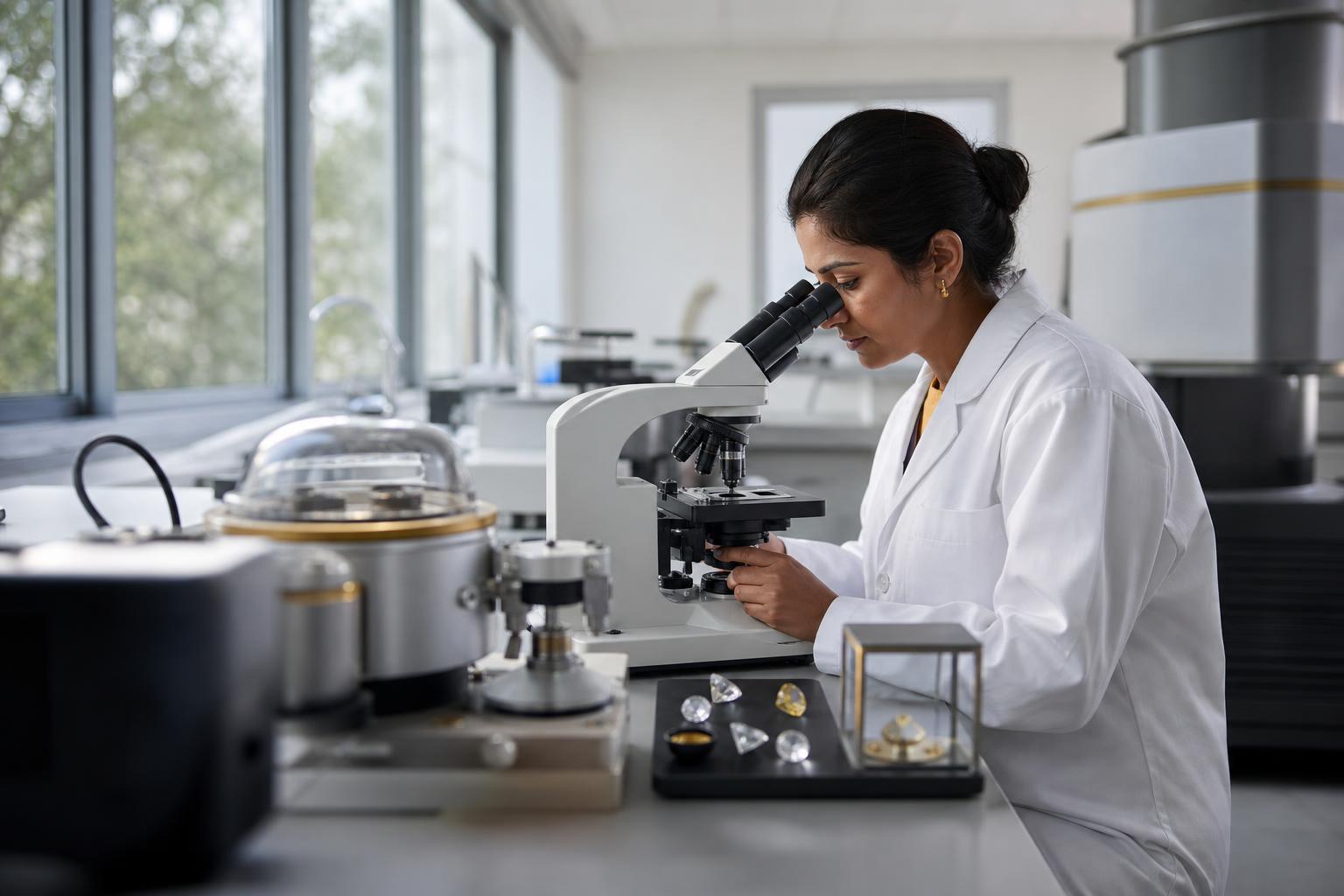
Every diamond on Earth formed under extraordinary conditions: carbon atoms crushed together over billions of years beneath the planet’s crust, at depths exceeding 150 kilometres. That process produced something remarkable, but it was never efficient. For every carat recovered from a mine, tonnes of earth had to be moved, sorted, and processed. The question of how lab-grown diamonds are made has shifted from scientific curiosity to commercial necessity over the past decade, and the answer matters enormously for jewellers building their businesses around these stones. Two primary technologies now replicate what geology achieved over millennia, doing so in weeks rather than eons. Understanding the science behind each method is not optional for trade buyers: it directly affects the quality, consistency, and commercial viability of the stones you stock. The distinction between a well-grown CVD diamond and a poorly controlled HPHT stone can mean the difference between a delighted customer and a return. Here is exactly what happens at the atomic level, why it matters for your margins, and where the technology is heading.
The Molecular Structure of Man-Made Diamonds
Are Synthetic Diamonds Real Diamonds?
The term “synthetic” causes more confusion in the trade than almost any other word. A synthetic ruby is still a ruby. A synthetic diamond is still a diamond. The Federal Trade Commission and the Gemmological Institute of America both confirm that lab-grown diamonds possess the same chemical composition, crystal structure, and physical properties as their mined counterparts. They are carbon, arranged in a face-centred cubic crystal structure, with a hardness of 10 on the Mohs scale and a refractive index of 2.42.
What separates them from simulants like cubic zirconia or moissanite is precisely this: the molecular structure of man-made diamonds is identical to natural diamonds. A simulant merely looks like a diamond. A lab-grown stone is a diamond, full stop. For jewellers fielding customer questions, this distinction is the single most important point to communicate clearly.
Defining the Carbon Lattice Arrangement
Diamond’s extraordinary properties stem from its lattice. Each carbon atom bonds covalently to four neighbouring atoms in a tetrahedral arrangement, creating an incredibly rigid three-dimensional network. This sp3 hybridisation is what gives diamond its hardness, thermal conductivity (around 2,200 W/mK), and optical brilliance.
Both HPHT and CVD methods must reproduce this lattice faithfully. Any deviation, such as the incorporation of nitrogen or boron atoms into the lattice, creates colour centres. Nitrogen produces yellow tints (Type Ib), while boron yields blue hues (Type IIb). The best lab-grown diamonds for commercial jewellery applications are Type IIa: essentially pure carbon with minimal impurities. Fewer than 2% of mined diamonds achieve this purity, yet most high-quality CVD stones are Type IIa by default. That is a genuine technical advantage worth communicating to your customers.
The Diamond Seed Crystallisation Process
The diamond seed crystallisation process begins with a thin plate of existing diamond, typically around 300 microns thick and 5-10mm across. This seed provides the template upon which new carbon atoms arrange themselves, copying the existing lattice structure layer by layer.
Seed quality determines everything. A seed with internal strain, inclusions, or lattice dislocations will propagate those defects into the growing crystal. Top manufacturers use seeds cut from previously grown high-quality diamonds, creating a virtuous cycle of improving purity across generations. The orientation of the seed also matters: most commercial production uses seeds cut along the (100) crystallographic plane, which promotes faster, more uniform growth.
Selecting and Preparing the Carbon Source
For HPHT growth, the carbon source is typically high-purity graphite. For CVD, it is methane gas (CH4), which provides individual carbon atoms when the molecular bonds are broken by plasma energy. In both cases, the carbon must be exceptionally pure. Contaminants measured in parts per million can shift a stone’s colour grade from D to K.
Preparation involves cleaning the seed ultrasonically, then positioning it precisely within the growth chamber. HPHT seeds sit in a metal flux (usually iron, nickel, or cobalt alloys) that acts as a solvent for carbon. CVD seeds are mounted on a substrate holder inside a vacuum chamber. The precision of this preparation stage directly influences the yield of commercially viable stones, which is why experienced manufacturers with controlled processes consistently outperform newer entrants on quality metrics.
Chemical Vapor Deposition vs High Pressure High Temperature
These two methods represent fundamentally different engineering philosophies. Understanding the differences between chemical vapor deposition vs high pressure high temperature is essential for any trade buyer evaluating stock, because the growth method affects a stone’s characteristics, grading profile, and even its resale narrative.
HPHT: Replicating Earth’s Natural Forces
HPHT mimics natural diamond formation by subjecting carbon to pressures of approximately 5-6 GPa (roughly 50,000 atmospheres) and temperatures between 1,300°C and 1,600°C. Three main press designs exist: the belt press, the cubic press, and the split-sphere (BARS) press. The cubic press dominates commercial production for larger stones due to its superior pressure uniformity.
Growth occurs over several days to two weeks, depending on target size. The carbon source dissolves in the metal flux at the hotter end of the capsule, migrates through the flux, and crystallises on the cooler seed. HPHT stones often exhibit cuboctahedral growth morphology and may contain metallic flux inclusions visible under magnification: a useful identification marker.
One commercial consideration: HPHT stones in the D-F colour range sometimes require post-growth treatment to remove residual yellow or brown tints caused by nitrogen incorporation. Reputable suppliers disclose all treatments, and grading reports from GIA or IGI will note them.
CVD: Precision Engineering through Plasma
CVD operates at much lower pressures (typically below 1 atmosphere) but uses plasma to break methane molecules into individual carbon and hydrogen atoms. The carbon atoms drift downward and bond to the diamond seed, building the crystal layer by layer at rates of roughly 0.1 to 10 microns per hour, depending on reactor conditions.
Microwave plasma CVD (MPCVD) is the dominant commercial method in 2026. The reactor creates a ball of plasma at temperatures exceeding 3,000°C directly above the seed, while the seed itself remains at 700-900°C. This temperature differential is critical for controlled growth. CVD diamonds tend to grow as flat, tabular crystals and are less likely to contain metallic inclusions than HPHT stones.
For jewellers, CVD stones in the 0.5-3ct range with D-H colour and VS2-SI1 clarity represent the commercial sweet spot. These are the specifications most frequently requested by UK retailers, and they are precisely the range where consistent supply matters most. Maitri Diamonds focuses its manufacturing on this specification window, which means trade partners can place repeat orders with confidence that quality, make, and availability remain stable.
Refining and Cutting Laboratory-Grown Gems
A rough lab-grown diamond emerging from a reactor looks nothing like the finished stone in a ring. CVD crystals often have a dark graphitic coating that must be removed, sometimes using HPHT treatment to improve colour before cutting begins. The rough is then mapped using 3D scanning technology to determine the optimal cut plan that maximises carat weight retention while achieving excellent light performance.
Cutting and polishing follow the same principles as natural diamonds: bruting to establish the girdle, then faceting on a scaife (polishing wheel) impregnated with diamond powder. The target is always to hit ideal proportions: for a round brilliant, that means a table percentage of 54-57%, a depth of 61-62.5%, and a crown angle near 34.5°. These parameters maximise brilliance, fire, and scintillation.
Post-cutting, every stone undergoes grading. Independent laboratories like IGI and GIA assess the 4Cs using the same criteria applied to mined diamonds. For trade buyers, consistency in make (the quality of the cut) across a parcel of stones is arguably more important than any single stone’s grade. A supplier whose stones consistently hit Very Good or Excellent cut grades across orders saves jewellers time on quality checks and reduces the risk of customer disappointment. Maitri Diamonds, rated 4.7 stars by customers for quality, consistency, and service on Google Reviews, maintains this consistency through vertically integrated manufacturing.
Environmental Impact of Lab Diamond Production
Energy Consumption and Carbon Footprint
The environmental impact of lab diamond production is a nuanced topic, and overly simplistic claims in either direction do the trade a disservice. A single carat of CVD diamond requires approximately 250-750 kWh of electricity, depending on reactor efficiency and growth conditions. HPHT stones require comparable energy but concentrated over shorter periods at higher power draws.
The critical variable is the energy source. A CVD diamond grown using hydroelectric power in Scandinavia has a carbon footprint a fraction of one grown using coal-fired electricity in parts of Asia. By 2026, an increasing number of manufacturers are transitioning to renewable energy sources, and some facilities operate entirely on solar or wind power. Ask your supplier about their energy sourcing: it is a legitimate differentiator and increasingly important to end consumers.
Ethical Sourcing and Supply Chain Transparency
Lab-grown diamonds eliminate several ethical concerns associated with mining: forced labour, conflict financing, and ecological destruction from open-pit operations. The supply chain is shorter and more traceable. A stone can be tracked from reactor to retailer with full chain-of-custody documentation.
For UK jewellers, this traceability simplifies compliance with consumer protection regulations and supports marketing claims about responsible sourcing. Customers in 2026 are asking pointed questions about provenance, and having clear answers builds trust. A manufacturing-backed supplier with direct oversight of production offers stronger assurances than a multi-layered trading chain where provenance becomes murky.
The Future of Sustainable Diamond Synthesis
The trajectory is clear: lab-grown diamond technology is becoming more energy-efficient, producing larger stones, and achieving higher average quality with each passing year. Reactor designs in 2026 are yielding rough crystals above 10 carats with increasing regularity, though the commercial jewellery market remains centred on the 0.5-3ct range where demand is strongest.
Price stabilisation is the other major trend. After years of rapid declines, wholesale prices for commercial-grade lab-grown diamonds have found firmer footing, with the rate of decline slowing significantly since late 2024. This gives jewellers more confidence in holding inventory without the fear of immediate devaluation. Smart stock management, supported by a supplier offering memo programmes and tailored inventory, allows independent jewellers to carry a compelling range without tying up excessive capital.
The science behind how lab-grown diamonds are produced will continue advancing, but the fundamentals will not change: carbon atoms, arranged in a perfect lattice, creating the hardest and most optically brilliant material known. For jewellers building a business around these stones, the priority is partnering with a supplier whose quality and availability you can rely on month after month. If you are looking to strengthen your lab-grown diamond offering, get in touch with Maitri Diamonds to discuss pricing, stock availability, or a supply arrangement built around your specific needs.